


Reader,
The current rhetoric…

Howd you take to it? Does he and others like him have a leg to stand on?
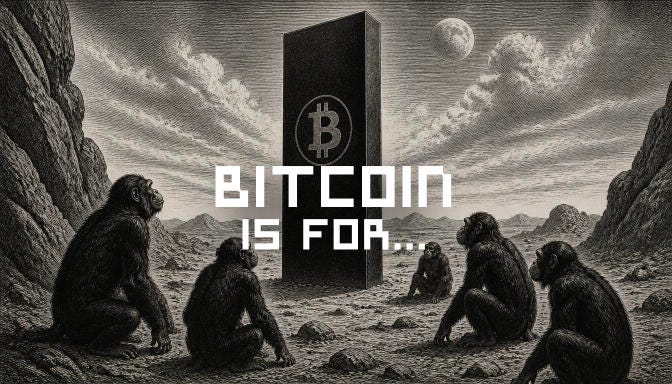
This years trend “Bitcoin is for noone.”
Last years was “Bitcoin is for anyone.”
The years before “Bitcoin is for everyone.”
So if no one is meant to verify code and no one is meant to run a node and no one understands what an xpub is, then dear reader, who is Bitcoin for exactly?
Bitcoin
A Peer to Peer Electronic Cash System
Abstract. A purely peer-to-peer version of electronic cash would allow online payments to be sent directly from one party to another without going through a financial institution.
In order to understand we must first define the terms.
Peer to peer in the whitepaper meant nodes on the same network. Not person to person. Not commerce.
Peers are independent validators. Endpoints enforcing identical rules. No central point of failure or revocation.
The ledger settles between peers.
Hal Finneys early frame tracked with sound money mechanics. Commercial layers float velocity and UX over a base that cannot be reorganized paused or debased by committee.1
Bitcoin does not bend to pressure.
As a result Bitcoin makes the accounting honest.
Cash in finance is a settlement state, not literal wallet user experience (UX).
I use to agree with Jack Dorseys stance. That Bitcoin would fail if it wasnt used for everyday payments.

That it was essential to Bitcoins survival. He had insights into the lives of everyday people through CashApp and Square.

Thinking more deeply over time Ive landed on the fact that Bitcoin is used in everyday payments but not in the way we would think.
The US banking system for all its flaws still functions. Settlements happen. Payments clear. It does not invalidate everyday Bitcoin use.
The Global South proves the case. Where monetary systems are unstable and where capital controls exist and where inflation erodes savings overnight there is Bitcoin.
Bitcoin does not compete against a working financial system. It is an alternative to a broken one.
With this new understanding the framework changes from person-to-person to node-to-node.
Does that mean Bitcoin is only for institutions?
No.
The whitepaper states clearly…
without going through a financial institution.
So to ask the question again: who is bitcoin for?
Sovereign Nations. They use it as a means of protection and defense against currency wars and sanctions.
Sovereign individuals and family offices. They use it as a hedge against jurisdictional risk and currency debasement. Property rights they control over convenience.
Institutions and reserve desks. They want a neutral settlement layer. Balance sheet hardening. They use multisig wallets or compliant custodians.
The tech literate minority. They run nodes. They audit code. They understand cyber security. They understand cryptography. With the help of Ai, individuals can join the ranks.
People who need a stable monetary base. Their own currency debases to zero and their payment network is unstable.
Hormuz routed payment through bitcoin.
Ukraine exit flows.
African capital preservation and Central American payment network. There is a layer of abstraction in order to have a smoother UX but it is one they are willing to accept.
They work because the Bitcoin network ignores borders. Doesnt freeze accounts. It has no seizure vectors. The second you need chargebacks or reversible fraud protection or subsidy-funded UX youre back in traditional finance.
Bitcoin delivers permissionless financial control.
It just doesnt do it by sanding down the rough edges. That keeps it capture-resistant.
The network stays boring so finality stays guaranteed.
But Rare… what about other cryptocurrencies?
They optimize for everyday payments. Faster blocks. Lower fees. Better UX.
Bitcoin didnt. It optimized for capture-resistance.
That tradeoff matters.
Faster consensus means shorter finality. Lower fees mean different security models. Better UX often means more trust placed elsewhere.
For a sovereign nation, a family office, or someone escaping capital controls those compromises are unacceptable.
They need the boring network that can’t be reorganized or seized.
Other cryptocurrencies solve the coffee shop problem. Bitcoin solves the sovereignty problem.
They are not competing.
They are serving different masters.
Bitcoins master is capture-resistance. Other coins other masters.
If you are willing to do the work you can verify the code. You can run the node. You can understand what an XPub is. All of these can be learned if you are willing to do the work.
Bitcoin is very much like the metals.
Anyone who is willing can custody their gold and silver coin. There is a responsibility that comes with it.
Many don’t.
If all youre looking for is price exposure and you don’t plan to spend any bitcoin at any point in time then an ETF might be the right tool for you.
If you do want to use Bitcoin but are too afraid of managing the infrastructure around it then maybe keeping your coin on an exchange is more up your alley.
For those willing to have control over their financial well being…
Bitcoin waits for you.
Rare
block height 960 821
In early writings I had disagreed with Hals take. Partly because I didnt fully understand what Bitcoin truly meant. It took me years. Years of reflection. I still do not fully understand how vast of an invention Bitcoin really is. Its impact is still yet to be known.